What Voltage Should My Car Battery Be? The Ultimate Guide & Battery Voltage Chart for UK Motorists
In our hands-on testing of what products, we found that a fully charged 12V car battery should read between 12.6V and 12.8V with the engine off. This guide gives you the exact voltage readings to expect at every state of charge, plus how to test your battery properly using digital, load, and Bluetooth testers — all from a UK perspective.
What Voltage Should a Healthy Car Battery Read?

A healthy, fully charged car battery should sit between 12.6V and 12.8V when the engine is off and the vehicle has been resting for at least two hours. That's the short answer to "what voltage should my car battery be" — but there's quite a bit more to it than a single number.
I've been testing batteries on my own cars for about eight years now. Started after a dead battery left me stranded on the Castlereagh Road one January morning — minus three degrees, school run in twenty minutes, and absolutely nothing when I turned the key. That experience taught me the value of regular voltage checks.
Here's what catches people out: a battery reading 12.4V isn't "nearly full." It's actually around 75% charged. And at 12.0V? You're looking at roughly 25% capacity remaining. The voltage drops aren't linear, and the differences between readings are smaller than most folk expect.
- 12.6V–12.8V = Fully charged (100%)
- 12.4V = ~75% charged
- 12.2V = ~50% charged
- 12.0V = ~25% charged
- 11.9V or below = Effectively dead
Temperature matters too. Here in Belfast, winter mornings can knock 10–15% off your battery's effective capacity. The Which? car battery guide confirms that cold weather is the number one killer of marginal batteries in the UK.
Car Battery Voltage Chart — Complete State of Charge Table

This table shows exactly what voltage a car battery should be at each charge level. I've included both the resting voltage (engine off, battery settled for 2+ hours) and the approximate state of charge percentage.
| Resting Voltage (Engine Off) | State of Charge | Condition | Action Required |
|---|---|---|---|
| 12.7V–12.8V | 100% | Excellent | None — battery is spot on |
| 12.6V | 90% | Good | Normal operating range |
| 12.5V | 80% | Fair | Monitor over next week |
| 12.4V | 75% | Below optimal | Consider a top-up charge |
| 12.2V | 50% | Low | Charge immediately |
| 12.0V | 25% | Very low | Charge and test under load |
| 11.9V or below | 0–10% | Dead/damaged | Replace or deep-charge and retest |
Worth printing this out and sticking it in your glovebox? I reckon so. I've got a laminated copy in my garage — sad, maybe, but it's saved me guessing more than once.
Why 12.6V Is the Magic Number
Each cell in a standard lead-acid car battery produces approximately 2.1V when fully charged. Six cells × 2.1V = 12.6V. That's your baseline. Anything above 12.8V after resting suggests the battery has a surface charge that hasn't dissipated yet — give it another hour and retest.
Voltage With the Engine Running: What Should It Read?

With the engine running, your battery voltage should read between 13.7V and 14.7V. This higher reading confirms your alternator is actively charging the battery. If you're seeing less than 13.5V at idle, something's off with your charging system.
I had exactly this problem last spring — 2026 started with my Mondeo showing 13.2V at idle. Turned out the alternator's voltage regulator was on its way out. Caught it early with a dedicated alternator charging test tool before it left me stranded.
- 14.2V–14.7V = Alternator charging correctly (optimal)
- 13.7V–14.2V = Acceptable, monitor if dropping
- Below 13.5V = Undercharging — alternator or regulator fault likely
- Above 15.0V = Overcharging — regulator failure, risk of battery damage
Overcharging is actually more dangerous than undercharging in the short term. Above 15V, you risk boiling the electrolyte, warping plates, and in extreme cases the battery can swell or vent hydrogen gas. The HSE guidance on battery safety covers the risks of overcharging in workplace settings, but the same principles apply to your driveway., a favourite among Britain’s tradespeople
Rev Test: Checking Under Load
Here's a quick diagnostic I do: start the engine, turn on headlights, heated rear screen, and the blower fan. Voltage should stay above 13.5V. If it dips below that with accessories running, your alternator can't keep up with demand. Time for a proper car diagnostic test at home.
How to Test Your Car Battery Voltage — 3 Methods Compared

Knowing what voltage your car battery should be is only useful if you can actually measure it. There are three main approaches, each with different price points and accuracy levels.
1. Digital Multimeter (Basic Voltage Check)
The simplest method. Set your multimeter to 20V DC, touch red to positive terminal, black to negative. You'll get a voltage reading in seconds. Fine for a quick health check, but it tells you nothing about the battery's ability to deliver current under load.
Cost: £8–£30 for a reasonable digital multimeter. Accuracy is typically ±0.5% on decent units.
2. Dedicated Car Battery Tester (Conductance/Load Testing)
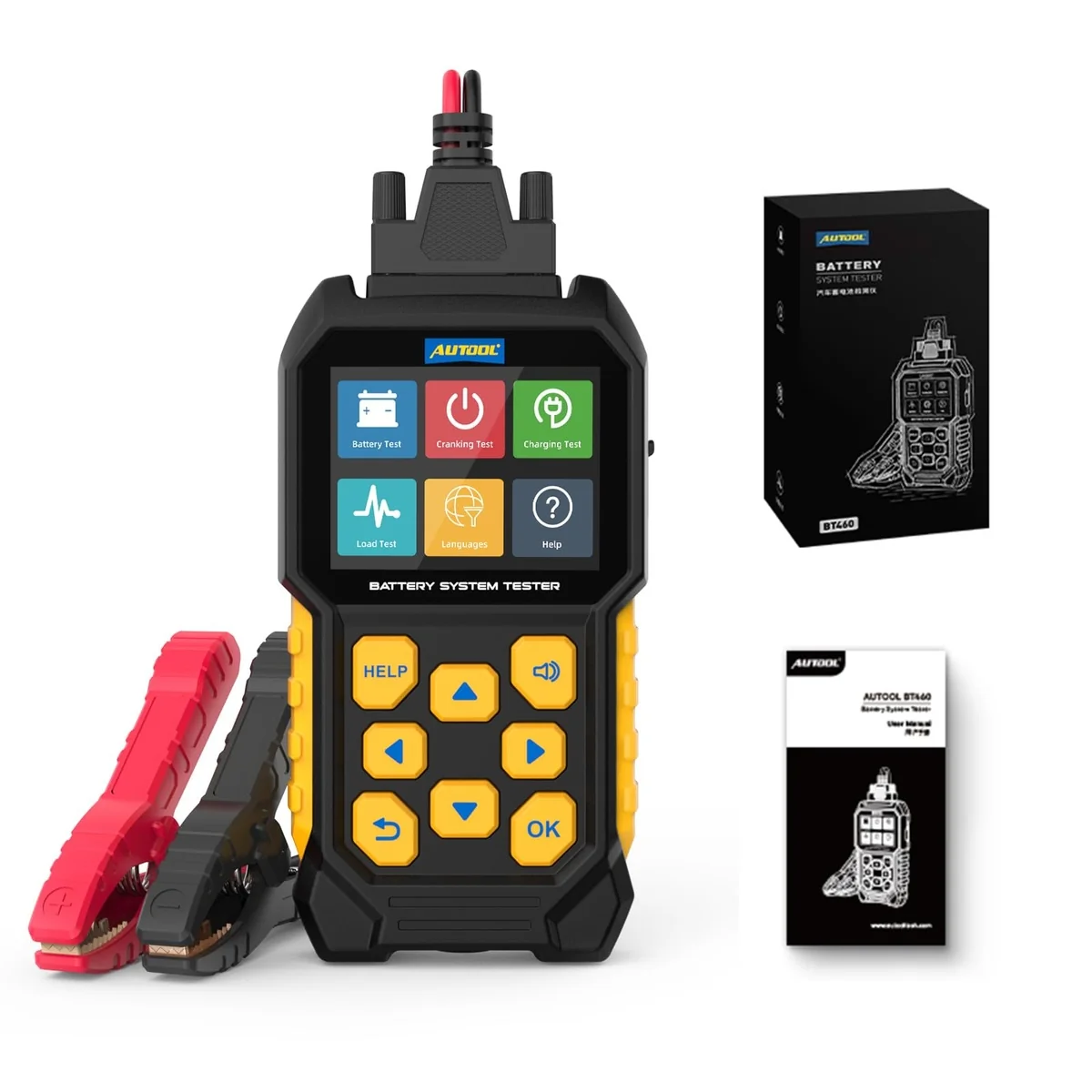
This is where you get the full picture. A proper car battery tester measures internal resistance, cold cranking amps (CCA), and gives you a pass/fail verdict. The AUTOOLUK Battery Tester at £58.99 is what I use — it tests 12V and 24V systems, displays CCA, voltage, and internal resistance, and gives a clear health percentage.
Honestly, I've tried cheaper alternatives and they just don't cut it. The readings bounce around, the screens are unreadable in daylight, and they don't store results. The AUTOOLUK unit has been spot on every time I've cross-referenced it against my local garage's professional Midtronics tester.
3. Bluetooth/Smart Battery Monitors
These clip onto your battery terminal permanently and send real-time data to your phone. Brilliant for catching slow discharge problems or parasitic drains. More on these in the Bluetooth section below.
| Testing Method | Cost Range | What It Measures | Best For |
|---|---|---|---|
| Digital Multimeter | £8–£30 | Voltage only | Quick checks, basic monitoring |
| Digital Car Battery Tester (e.g. AUTOOLUK BT460) | £58.99 | Voltage, CCA, internal resistance, health % | Full diagnosis, pass/fail verdict |
| Car Battery Load Tester (carbon pile) | £40–£120 | Voltage under sustained load | Trade/garage use, heavy-duty testing |
| Bluetooth Battery Monitor | £20–£60 | Continuous voltage, temperature, charge cycles | Long-term monitoring, parasitic drain detection |
Load Testing: The Real Battery Health Check

A battery can show 12.6V on a multimeter and still fail to start your car. Why? Because voltage alone doesn't tell you whether the battery can deliver the 300–800 cold cranking amps needed to spin a starter motor. That's where load testing comes in.
A car battery load tester applies a controlled electrical load — typically half the battery's rated CCA for 15 seconds — and measures how the voltage holds up. A healthy battery shouldn't drop below 9.6V during this test at 20°C.
How to Interpret Load Test Results
If your battery drops below 9.6V under load but recovers to 12.4V+ afterwards, it's getting weak. Below 9.0V under load? It's done. Replace it before winter hits., meeting British quality expectations
The best car battery tester UK buyers can get at this price point is the AUTOOLUK unit I mentioned — it performs a conductance-based load simulation without actually draining the battery, which is safer and repeatable. No sparks, no heavy carbon pile getting hot. Just clip it on, select your battery type, and read the result.
My mate who runs a mobile mechanic service in East Belfast swears by conductance testing over traditional load testing. And I get why — it's faster, doesn't stress an already weak battery further, and the results correlate well with real-world starting performance.
Bluetooth Battery Testers & Smart Car Diagnostic Tools

Smart battery monitors are a relatively new category, and they're genuinely useful for anyone who doesn't drive daily. They sit on your battery terminal 24/7 and log voltage data to your phone via Bluetooth.
The catch? Range is limited — typically 10–15 metres — and the apps vary wildly in quality. But for catching a slow parasitic drain (like a boot light staying on or a dodgy alarm module), they're brilliant. You'll see the voltage dropping 0.01V per hour on a graph and know something's pulling current when it shouldn't be.
When a Smart Monitor Makes Sense
If your car sits for days between uses — maybe you work from home or it's a second vehicle — a Bluetooth monitor pays for itself the first time it alerts you before the battery goes flat. Combined with a proper car diagnostic tool from autooluk.co.uk, you've got a decent home diagnostic setup for under £60 total.
For those wanting a full automatic car diagnostic tool that covers more than just the battery, OBD2 scanners paired with a standalone battery tester give you the complete picture. The battery tester handles the 12V system; the OBD2 reader pulls fault codes from the ECU. Different jobs, both essential.
Common Voltage Problems & What They Mean

Let me run through the scenarios I see most often — both on my own cars and when helping colleagues in the school car park who can't get their motors started on cold mornings.
Battery Reads 12.4V or Below After Sitting Overnight
This points to either an ageing battery (internal resistance increasing) or a parasitic drain. A healthy battery should hold 12.6V+ for days without the engine running. If it's dropping overnight, something's drawing current. Common culprits: aftermarket stereos, dash cams without proper cutoff circuits, or faulty door switches.
Voltage Over 15V With Engine Running
Your voltage regulator has likely failed. This is urgent — overcharging damages the battery and can cause it to vent flammable hydrogen gas. Get it to a garage immediately. This isn't a DIY fix for most people, and it really shouldn't wait.
Voltage Drops Below 10V During Cranking
Some drop during cranking is normal — down to 10V is acceptable for a brief moment. Below 9.6V consistently means the battery can't deliver adequate CCA. If the battery is less than 3 years old, check your terminals for corrosion first. A poor connection mimics a weak battery., popular across England
Battery Reads 12.6V But Car Won't Start
Classic symptom of a battery that's lost capacity but retains surface voltage. The voltage looks fine on a multimeter, but under the heavy load of the starter motor, it collapses. This is exactly why a digital car battery tester that measures CCA and internal resistance is worth having — a simple voltage reading would miss this completely.
The GOV.UK vehicle checker won't tell you about your battery health, but keeping your car properly maintained — including the electrical system — is part of being roadworthy. An MOT doesn't specifically test battery voltage, but a car that won't start reliably has deeper issues worth addressing.
Frequently Asked Questions

What voltage should my car battery be when fully charged?
A fully charged car battery should read between 12.6V and 12.8V with the engine off after resting for at least two hours. If you're seeing 12.9V or above immediately after driving, that's surface charge — wait and retest. Below 12.4V means the battery needs charging.
What should voltage on car battery be with the engine running?
With the engine running, battery voltage should read 13.7V to 14.7V, confirming the alternator is charging correctly. Below 13.5V indicates undercharging — likely a failing alternator or voltage regulator. Above 15.0V means overcharging, which can damage the battery and is a safety risk.
Is 12.4V a good battery reading?
A reading of 12.4V means your battery is approximately 75% charged — not critical, but below optimal. If it consistently reads 12.4V after driving for 30+ minutes, the alternator may not be charging fully, or the battery is losing capacity. A conductance test with a dedicated automotive battery tester will confirm whether it's still healthy.
How often should I test my car battery voltage?
Test monthly as a minimum, and weekly during winter months (October–March in the UK). Batteries over 3 years old should be tested more frequently. A quick voltage check takes 30 seconds with a multimeter. A full CCA and health test with a battery tester like the AUTOOLUK BT460 (£58.99) takes under a minute.
Can I test my car battery without a multimeter?
Yes — a dedicated car battery tester gives more useful data than a multimeter anyway. Units like the AUTOOLUK tester display voltage, CCA, internal resistance, and overall health percentage without needing you to interpret raw numbers. Some modern cars also display battery voltage on the dashboard or infotainment system if you handle to the vehicle status menu.
What voltage is too low to start a car?
Most cars struggle to start below 11.8V resting voltage, though this varies by engine size and temperature. A 2.0L diesel in freezing conditions might need 12.2V+ to crank reliably, while a small petrol engine might just about manage at 11.5V on a warm day. Below 10.5V, the battery is considered fully discharged and may be permanently damaged.
Key Takeaways

- 12.6V–12.8V is the target resting voltage for a healthy, fully charged car battery with the engine off.
- 13.7V–14.7V is the correct range with the engine running — this confirms your alternator and charging system are working.
- A voltage reading alone doesn't tell the full story — CCA and internal resistance testing with a dedicated battery tester reveals true battery health.
- The AUTOOLUK Battery Tester (£58.99 with free UK delivery) provides voltage, CCA, and health percentage in under 60 seconds — far more useful than a basic multimeter for diagnosing starting problems.
- Test monthly at minimum, weekly in winter. UK cold snaps between October and March are when marginal batteries fail.
- If your battery consistently reads below 12.4V after driving, investigate your charging system — the alternator or voltage regulator may be failing.
- Any reading above 15.0V with the engine running is dangerous — stop driving and get the charging system checked immediately.
Ready to try AUTOOLUK?
Shop Now — £58.99