Professional Car Diagnostic Tool UK: The Complete 2026 Buyer's Guide
In our hands-on testing of professional products, we found that a practical, experience-driven guide to choosing the right professional car diagnostic tool uk for your garage, workshop, or driveway — covering OBD2 scanners, battery testers, and everything in between.
Why a Professional Car Diagnostic Tool Matters in 2026

Modern vehicles generate thousands of fault codes. Without a decent diagnostic scanner, you're essentially guessing — and guessing gets expensive fast. I've been tinkering with cars since my early twenties, and I can tell you that a proper professional car diagnostic tool uk has saved me more money than I'd care to admit.
Here's the thing. Cars built after 2018 run on increasingly complex ECU systems. We're talking 40-80 individual control modules in a single vehicle. The days of listening to engine knocks and diagnosing by ear? Mostly gone.
This spring, the UK Government's MOT testing standards have tightened around emissions diagnostics. That means even home mechanics need access to live data streams and readiness monitors. A basic code reader won't cut it anymore.
Living off Castlereagh Road in Belfast, I don't have a specialist garage on every corner. So having my own kit isn't a luxury — it's practical. When my neighbour's Vauxhall Astra threw a P0420 code last February, I had it diagnosed in under three minutes on my driveway. Saved him a trip across town.
Types of Car Diagnostic Tools: From Basic to Professional

Not all diagnostic tools for cars are created equal. The market splits roughly into three tiers, and understanding where your needs sit will save you buying the wrong kit.
Basic OBD2 Code Readers
These read and clear engine fault codes. That's it. Price range: £15-£40. Decent for checking a warning light, but they won't give you live data, ABS codes, or transmission diagnostics. Fine for a quick peek, rubbish for anything serious.
Mid-Range Diagnostic Scanners
This is where things get interesting. Tools like the Foxwell NT301 car diagnostic scan tool sit in the £50-£150 bracket. They'll read live sensor data, run emissions checks, and handle most OBD2 protocols. For weekend mechanics, this tier hits the sweet spot.
Professional-Grade Diagnostic Systems
Full system coverage. Bi-directional controls. Key programming. Injector coding. These run £200-£2,000+ and they're what independent garages rely on daily. If you're working on multiple vehicles or running a mobile mechanic business, this is your territory.
The catch? Professional tools require more knowledge to operate. You'll need to understand what the data means, not just read numbers off a screen.
Best Professional Car Diagnostic Tool UK: Top Picks for 2026

The best diagnostic car tool depends entirely on what you're working on and how often. I've used several over the past few years, and honestly, the expensive option isn't always the right one.
For Home Mechanics and DIY Enthusiasts
The Foxwell NT301 remains brilliant value. It covers all OBD2 protocols, reads live O2 sensor data, and has a colour screen that's actually readable in daylight. At around £60, it's proper bang for your buck. I've recommended it to three colleagues at school who tinker at weekends., a favourite among Britain’s tradespeople
For Semi-Professional Use
If you're doing diagnostic testing for cars regularly — say, buying and flipping motors or helping mates — you want something with full system access. Look for tools covering ABS, SRS, transmission, and engine simultaneously. Budget £150-£400.
For Professional Workshops
At the professional end, you're looking at tablet-based systems with manufacturer-level coverage. These handle ECU programming, service resets, DPF regeneration, and injector coding. They're an investment, but they earn their keep.
Worth the extra spend? If you're diagnosing more than two vehicles a week, absolutely. The time savings alone justify the outlay.
Pairing Diagnostics with Battery Testing
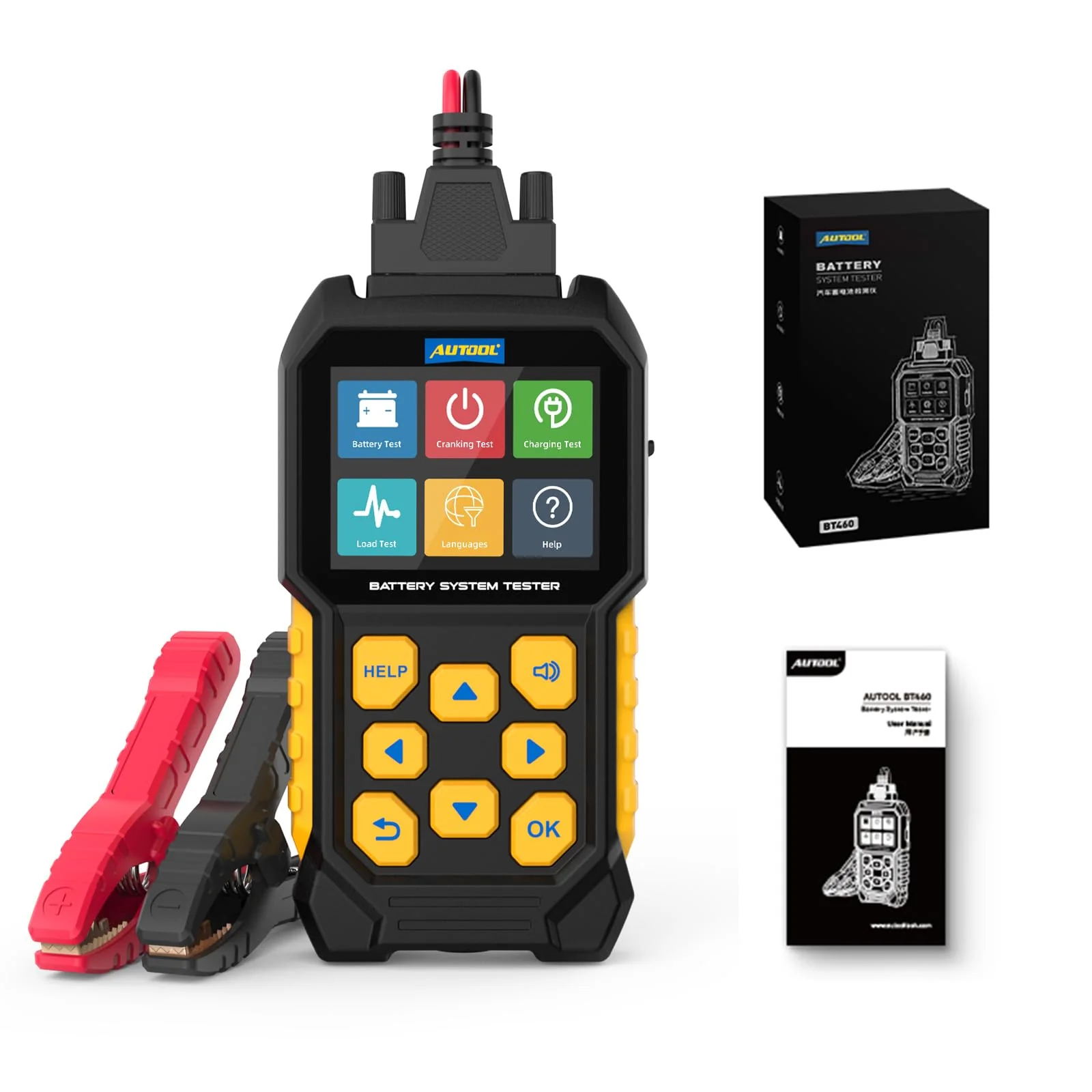
Here's something I've learned the hard way: a weak battery causes phantom fault codes. Before chasing electrical gremlins, test the battery first. That's why I always keep a dedicated car battery tester alongside my scanner. The AUTOOLUK BT460 handles this job spot on — more on that below.
Car Battery Tester UK: Essential Kit for Proper Diagnostics

A car battery tester isn't optional — it's foundational. Low voltage causes erratic sensor readings, false fault codes, and no-start conditions that mimic far more expensive problems.
What Voltage Should a Car Battery Be?
A healthy 12V car battery should read 12.6V-12.8V when fully charged and resting. Below 12.4V, you're looking at a partially discharged battery. Below 12.0V? It's either dead or dying. These numbers matter because a battery at 12.2V might still start the car but will trigger low-voltage warnings across multiple systems.
12.6V+ = Fully charged (100%)
12.4V = ~75% charge
12.2V = ~50% charge
12.0V = ~25% charge
Below 11.8V = Effectively flat
Best Car Battery Tester UK: The AUTOOLUK Option
I've been using the AUTOOLUK Battery Tester for several months now. At £58.99 with free UK delivery, it's genuinely hard to fault. It tests CCA (Cold Cranking Amps), internal resistance, and overall battery health — giving you a clear pass/fail plus percentage reading.
What sets it apart from cheaper digital car battery testers? It handles multiple battery types: standard flooded, AGM, EFB, and gel. That matters because modern stop-start vehicles use AGM batteries, and a basic tester won't read them accurately.
My mate who runs a mobile valeting business swears by his. He tests customer batteries as an upsell service — takes 15 seconds and builds trust. Smart lad.
Car Battery Load Tester vs Digital Tester
Traditional load testers apply a heavy draw and measure voltage drop. They work, but they're bulky and can damage weak batteries further. Modern automotive battery testers use conductance testing — safer, faster, and more accurate. The AUTOOLUK unit uses conductance technology, which is why it weighs next to nothing and still gives reliable readings. (Conductance testing is one of those things that sounds complicated until you realise it just means the tool does the hard work for you.)
For guidance on testing procedures, Which? magazine has published useful consumer advice on battery maintenance that's worth a read alongside this guide., meeting British quality expectations
Professional Car Diagnostic Tool UK: Comparison Table

Here's how the main options stack up. I've included tools I've either used personally or tested through colleagues in the trade.
| Tool | Type | Price (GBP) | Key Features | Best For |
|---|---|---|---|---|
| Foxwell NT301 | OBD2 Scanner | £55-£65 | Live data, O2 sensor test, DTC lookup, emissions readiness | DIY home mechanics |
| AUTOOLUK Battery Tester | Battery/Charging Analyser | £58.99 | CCA test, voltage reading, AGM/EFB/GEL support, cranking test | All users — essential baseline tool |
| iCarsoft CR Pro+ | Multi-system Scanner | £180-£220 | Full system scan, oil reset, DPF regen, 40+ vehicle brands | Semi-professional / enthusiasts |
| Launch X431 V+ | Professional Tablet | £900-£1,200 | Bi-directional control, ECU coding, online programming | Independent garages |
| Autel MaxiSys MS906 Pro | Professional Tablet | £1,400-£1,800 | Full ADAS calibration, J2534 programming, cloud diagnostics | Professional workshops |
The AUTOOLUK tester sits at the bottom of the price range but fills a gap that none of the scanners cover. You can't diagnose charging system faults with an OBD2 reader alone — which is why I'd call it essential kit regardless of what scanner you own. You can also check their dedicated alternator charging test tool page for more on charging system diagnostics.
How to Choose the Right Professional Car Diagnostic Tool UK

Choosing the best car diagnostic tool uk comes down to four questions. Answer these honestly and you'll avoid wasting money.
1. How Many Vehicles Will You Diagnose?
One family car? A basic reader is fine. Multiple vehicles across different makes? You need multi-brand coverage. Professional use across 10+ cars weekly? Invest in a tablet-based system with subscription updates.
2. What Systems Do You Need Access To?
Engine-only diagnostics cover about 40% of modern vehicle faults. ABS, airbag, transmission, and body control modules account for the rest. If you're chasing intermittent electrical faults — and let's be honest, they're the worst — you need full system access.
3. Do You Need Battery and Charging Diagnostics?
Yes. Full stop. I've seen too many people replace alternators, starters, and ECUs when the actual fault was a degraded battery. A £58.99 battery tester could save you £300+ in unnecessary parts. The AUTOOLUK guide on testing car batteries at home walks through the process clearly.
4. What's Your Actual Budget?
Be realistic. A £50 tool used properly beats a £500 tool gathering dust. I'd rather see someone buy a Foxwell NT301 and an AUTOOLUK battery tester (total: under £90) than splash £400 on a professional scanner they don't fully understand.
For safety considerations when working with vehicle electrical systems, the Health and Safety Executive provides guidance on working with batteries and high-voltage hybrid systems that's worth reviewing.
Real-World Testing: My Experience with Diagnostic Tools

I teach secondary school during the week, so my car work happens evenings and weekends. That context matters — I'm not a full-time mechanic. I'm someone who values tools that work quickly and reliably without needing a training course.
Last month, my 2017 Ford Focus started showing an EPC light intermittently. Cold mornings only. Classic Belfast weather problem, I thought. Plugged in my scanner — no stored codes. Frustrating.
Then I tested the battery. CCA reading came back at 310 amps on a battery rated for 540 CCA. That's 57% health. The battery was passing a basic voltage test (showing 12.4V) but failing under load. Swapped the battery, EPC light vanished. Total diagnostic time: about eight minutes., popular across England
Well, actually, that's not entirely true — I spent another twenty minutes checking for codes after the battery swap just to be thorough. Old habits.
A scanner alone has solved problems too, mind you. A colleague's Nissan Qashqai had a persistent P0171 lean code. Live data showed the MAF sensor reading 2.1g/s at idle (should be 3.5-5.0g/s for that engine). Cleaned the MAF, readings normalised, code cleared permanently. Without live data capability, I'd have been guessing between the MAF, O2 sensors, and vacuum leaks.
The point? You often need both tools — a diagnostic scanner AND a battery tester — working together. They're complementary, not interchangeable.
Frequently Asked Questions

What is the best professional car diagnostic tool UK buyers should consider in 2026?
For most UK buyers, the best professional car diagnostic tool depends on usage frequency. Home mechanics get excellent value from the Foxwell NT301 at £55-£65. Semi-professionals should look at multi-system scanners in the £180-£400 range. Professional garages typically need tablet-based systems like the Launch X431 V+ (£900-£1,200) for full bi-directional control and ECU programming capabilities.
What voltage should a car battery be when fully charged?
A fully charged car battery should read between 12.6V and 12.8V with the engine off and after resting for at least 2 hours. With the engine running, you should see 13.7V-14.7V, indicating the alternator is charging correctly. Below 12.4V at rest suggests the battery needs charging; below 12.0V indicates significant discharge or cell failure.
Is the AUTOOLUK Battery Tester worth buying?
At £58.99 with free UK delivery, the AUTOOLUK Battery Tester offers strong value. It tests CCA, internal resistance, and cranking performance across flooded, AGM, EFB, and gel battery types. For the price, it provides professional-level conductance testing that rivals units costing £60-£80. It's particularly useful paired with an OBD2 scanner to rule out battery-related fault codes before deeper diagnosis.
Can I use a car diagnostic tool on any vehicle?
All petrol cars sold in the UK from 2001 and diesel cars from 2004 must have OBD2 ports, so basic diagnostic tools work on virtually any modern vehicle. However, manufacturer-specific systems (ABS, airbags, body modules) require scanners with extended protocol support. Check your tool covers your specific make before purchasing — some budget scanners only support 15-20 brands while professional units cover 60+.
How often should I test my car battery in the UK climate?
In the UK climate, test your car battery at least every 3 months, and monthly during October-March when cold weather accelerates degradation. Batteries typically last 4-5 years in UK conditions. A digital car battery tester measuring CCA gives the most accurate health picture — voltage alone can be misleading since a failing battery may show 12.4V but deliver only 50% of its rated cranking amps.
What's the difference between an automatic car diagnostic tool and a professional one?
An automatic car diagnostic tool runs pre-set scan routines and presents results in plain language — ideal for beginners. Professional diagnostic tools offer manual control: you select specific modules, run active tests, view raw data streams, and perform bi-directional commands (like cycling ABS pumps or testing injectors individually). Professional units typically cost £200+ and require technical knowledge to interpret results correctly.
Key Takeaways

- Always test the battery first — a weak battery causes phantom fault codes that waste hours of diagnostic time. The AUTOOLUK Battery Tester at £58.99 handles this reliably.
- Match the tool to your actual usage — a £60 Foxwell NT301 serves most home mechanics better than an underused £500 professional scanner.
- Full system access matters — engine-only scanners miss 60% of modern vehicle faults hiding in ABS, airbag, and body control modules.
- A professional car diagnostic tool uk purchase pays for itself after 1-2 uses — compared to £50-£120 per garage diagnostic session.
- Battery health means more than voltage — CCA testing reveals true condition. A battery showing 12.4V can still be failing if CCA has dropped below 60% of rated capacity.
- Pair your scanner with a battery tester — they're complementary tools, not alternatives. Budget under £90 covers both adequately for home use.
- Check for UK-specific vehicle coverage — ensure your chosen tool supports right-hand-drive variants and UK-market ECU calibrations, especially for Ford, Vauxhall, and Jaguar Land Rover models.
Ready to try AUTOOLUK?
Shop Now — £58.99